Since the European Union signed trade agreements with Mercosur, the South American trade bloc, and with India – both in January – it has been eyeing the swift conclusion of free trade agreements with Thailand and other Southeast Asian countries.
But in its rush to diversify trading partners amid growing global uncertainty, the EU should not sacrifice the potential of trade negotiations to improve rights and address abusive practices. Regarding Thailand, the focus should be squarely on the labor rights of migrant workers.
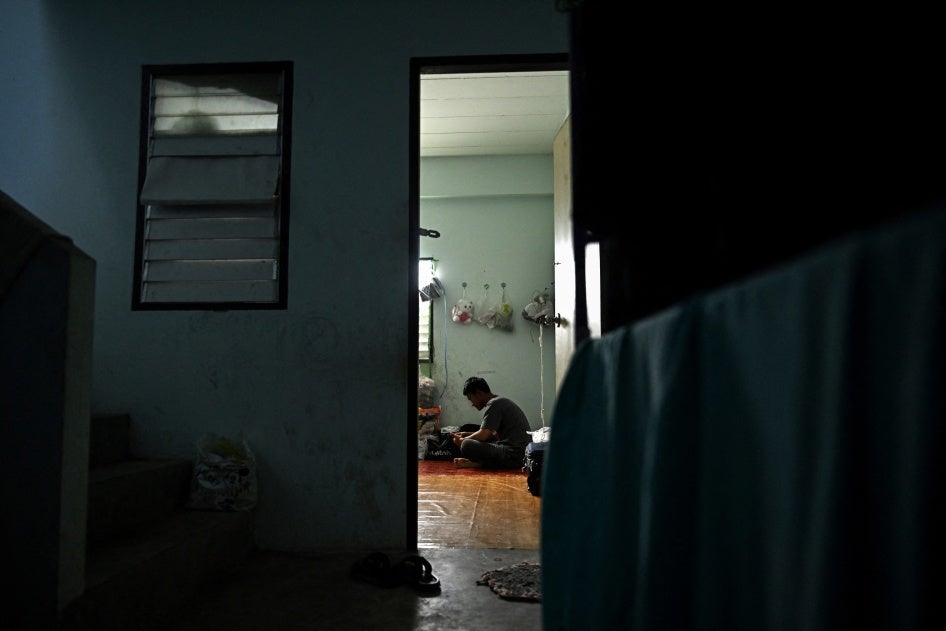
Thailand’s economy relies on millions of registered migrant workers, primarily from Myanmar, Cambodia, Laos, and Vietnam. Millions more from these countries are undocumented – including 1.8 million from Myanmar – and are vulnerable to exploitation, including in the major business sectors of fisheries and construction. Undocumented migrants are at risk of harassment, arrest, and deportation. All migrant workers in Thailand are barred by Thailand’s Labor Relations Act from establishing labor unions.
Thailand has yet to ratify two core International Labor Organization (ILO) conventions, namely the 1948 Convention on Freedom of Association and Protection of the Right to Organize and the 1949 Convention on the Right to Organize and Collective Bargaining.
The EU has played a positive role in Thailand’s notoriously abusive fishing industry. In 2015, it handed a “yellow card” to Thailand for not taking sufficient measures in the international fight against illegal, unreported and unregulated fishing, which pushed Thai authorities to act amid serious risk of import bans to the EU. The yellow card was lifted in 2019 in recognition of Thailand’s substantial progress in addressing the issue.
The ongoing trade negotiations offer a vital opportunity to secure major improvements for migrant workers’ rights in Thailand, but the EU needs to recognize that the standard way of proceeding with trade negotiations won’t do.
EU trade deals typically include a “trade and sustainable development” chapter, in which both sides agree on labor rights, good governance, and environmental protection. Standard language includes an obligation for each party to “make continued and sustained efforts to ratify the fundamental ILO Conventions to which they are not yet party.” But the obligation is vague and not timebound, making the indefinite postponement of ratification possibly compatible with the deal.
The EU’s trade agreement with Vietnam illustrates the weakness of this approach. Ahead of the European Parliament’s 2020 vote on the EU-Vietnam agreement, Hanoi pledged to ratify all remaining core ILO conventions by 2023. But Vietnam has yet to ratify the ILO convention on freedom of association, and the EU finds itself largely unable to deal with Hanoi’s broken promises.
Last year, several civil society groups filed a complaint with the EU, claiming that Vietnam’s intensifying repression is in breach of the trade deal. Yet the EU, while fully aware of Hanoi’s growing abuses, recently upgraded its bilateral partnership with Vietnam, putting into question its commitment to its own foundational obligations to promote human rights in its foreign policy, including through trade.
While one can’t compare Vietnam’s and Thailand’s political systems, the EU should learn from its mistakes to better address Bangkok’s chronic reluctance to grant basic labor rights to migrant workers. It could negotiate a binding protocol for labor reforms and ILO ratification, with clear penalties, and offer legal and technical assistance to address any possible non-political obstacle. The bare minimum would be a public roadmap for labor reforms and ILO ratification, or the trade agreement would fall below the already low baseline set with Vietnam.
Clear, timebound and public commitments would be a powerful advocacy tool for Thai lawmakers, trade unions, civil society groups and the EU itself, building pressure on the Thai government to deliver on its own pledges and improve the labor conditions of millions of workers stuck in abusive conditions.
Besides “ethical” arguments and compliance with EU treaties, securing labor rights improvements would also be in the interest of EU companies, considering growing investments in Thailand. Without a solid legal protection framework, they risk employing workers in abusive conditions, facing legal and reputational liability that could, in turn, discourage them from doing business in the country.
Furthermore, the EU’s forced labor regulation will prohibit products made with forced labor from entering the EU market from December 2027. Abusive conditions suffered by migrant workers in the country risk falling under the scope of the regulation, potentially blocking exports to Europe and diminishing the FTA’s economic potential for Thailand.
The EU and Thailand have every interest to lead by example and use trade to foster sustainable development, showing that they don’t accept the continued exploitation of migrant workers as fuel for economic growth. All they need to do is put that commitment black on white, set a schedule for labor reforms and ILO ratification, and work together, along with civil society, trade unions, the ILO and migrant workers themselves, toward rights-respecting trade that will ultimately also benefit business, investments and exports.